Keller Williams Mid Willamette real estate agent

Keller Williams Mid Willamette real estate agent
Steve Frisbie is a licensed real estate agent in the State of Oregon. REALTOR®. Equal Opportunity Housing Provider. Each office is independently owned and operated.

Wednesday, October 10, 2018

Buy vs. Rent... Can you be better off by paying a lower down payment and NOT saving for a larger down payment?? Here's some thoughts....

Realtors often hear "I'm saving up for my down payment, we're a few years away".  Keep in mind the phrase "there's more than one way to skin a cat", and with financing home purcahses that often is true as well.

The following article uses a 250K home purchase and runs some of the numbers to give you an example of what can happen. Keep in mind, not all type of loans are exactly the same, and the numbers may or may not work for you, so it's always a great idea to get in contact with a couple of different loan officers and types of lending institutions to have them run the numbers for you when you start thinking about purchasing a home.

 You just may find that you might be able to get into a new home sooner than you think, and at the very least you will come out more informed and have a better idea of what you need to do to make the purchase of a home happen for you.


The Cost of NOT Paying PMI

There is a common misconception among homebuyers that a 20% down payment is required, and it is this limiting belief that often adds months, and sometimes even years, to the home-buying process.

So, if you can purchase a home with less than a 20% down payment… why aren’t more people doing just that?

One Possible Answer: Private Mortgage Insurance (PMI)
Freddie Mac defines PMI as:
“An insurance policy that protects the lender if you are unable to pay your mortgage. It’s a monthly fee, rolled into your mortgage payment, that is required for all conforming, conventional loans that have down payments less than 20%.
Once you’ve built equity of 20% in your home, you can cancel your PMI and remove that expense from your mortgage payment.”
As the borrower, you pay the monthly premiums for the insurance policy, and the lender is the beneficiary. The monthly cost of your PMI depends on the home’s value, the amount of your down payment, and your credit score.
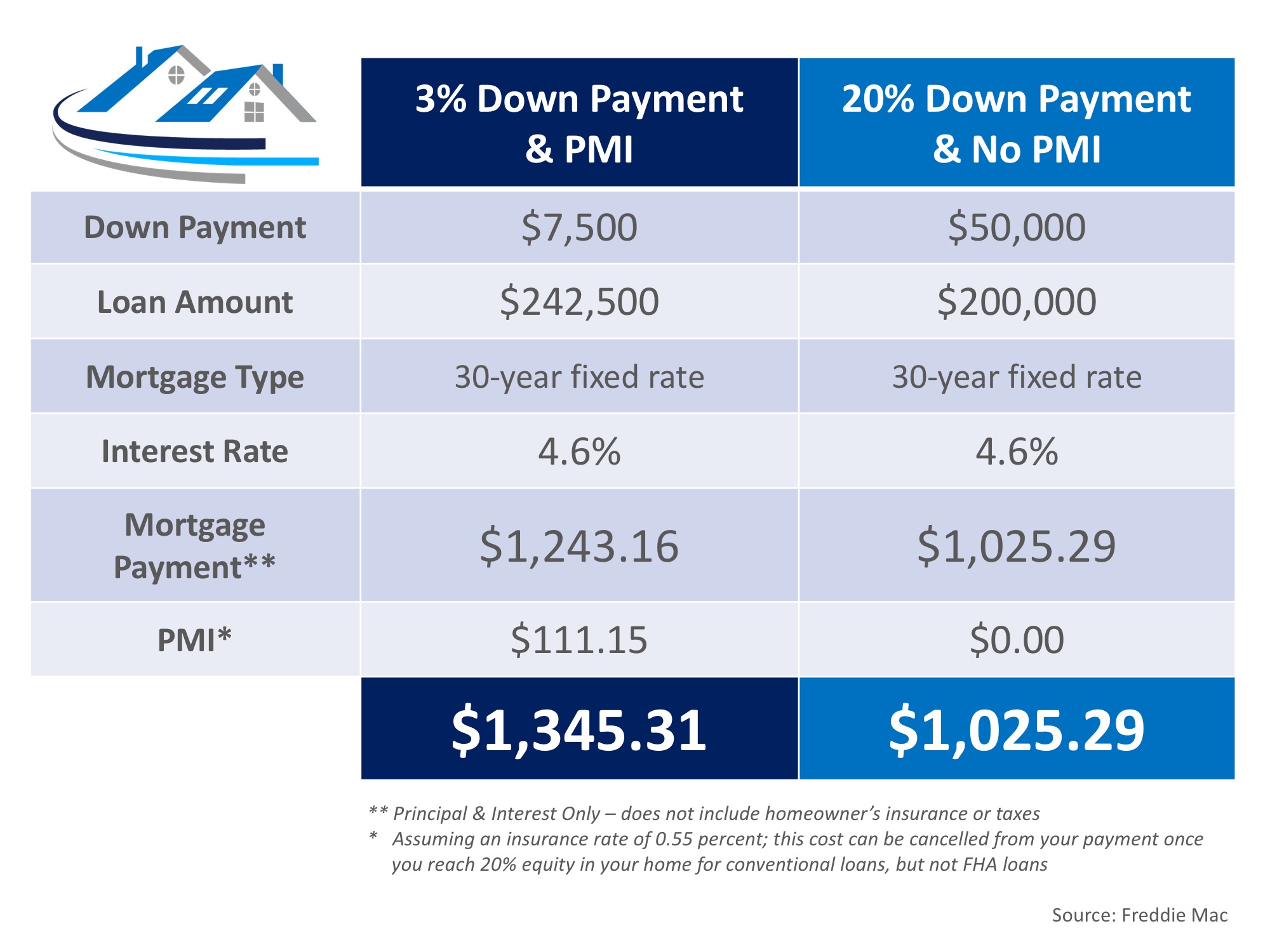
Below is a table showing the difference in monthly mortgage payment for a $250,000 home with a 3% down payment and PMI vs. a 20% down payment without PMI:
The Cost of NOT Paying PMI | Simplifying The Market
The first thing you see when looking at the table above is no doubt the added $320 a month that you would be spending on your monthly mortgage cost. The second thing that should stand out is that a 20% down payment is $50,000!
If you are buying your first home, $50,000 is a large sum of money that takes discipline and sacrifice to save. Many first-time buyers save for 5-10 years before buying their homes.
To save $50,000 in 10 years, you would need to save about $420 a month. On the other hand, if you save that same $420 a month, you could afford a 3% down payment in less than a year and a half.
In a recent article by My Mortgage Insider, they explain what could happen in the market while you are waiting to save for a higher down payment:
“The time it takes to save a (larger) down payment could mean higher home prices and tougher qualifying down the road. For many buyers, it could prove much cheaper and quicker to opt for the 3% down mortgage immediately.”
The article went on to say,
“Since renters typically devote a higher percentage of their income to housing than homeowners, providing flexible down payment options can help renters with solid earnings purchase a home – and gain a fixed-rate mortgage with principal and interest payments that will not increase over the life of the loan.”
If the prospect of having to pay PMI is holding you back from buying a home today, Freddie Mac has this advice,
“It’s no doubt an added cost, but it’s enabling you to buy now and begin building equity versus waiting 5 to 10 years to build enough savings for a 20% down payment.”
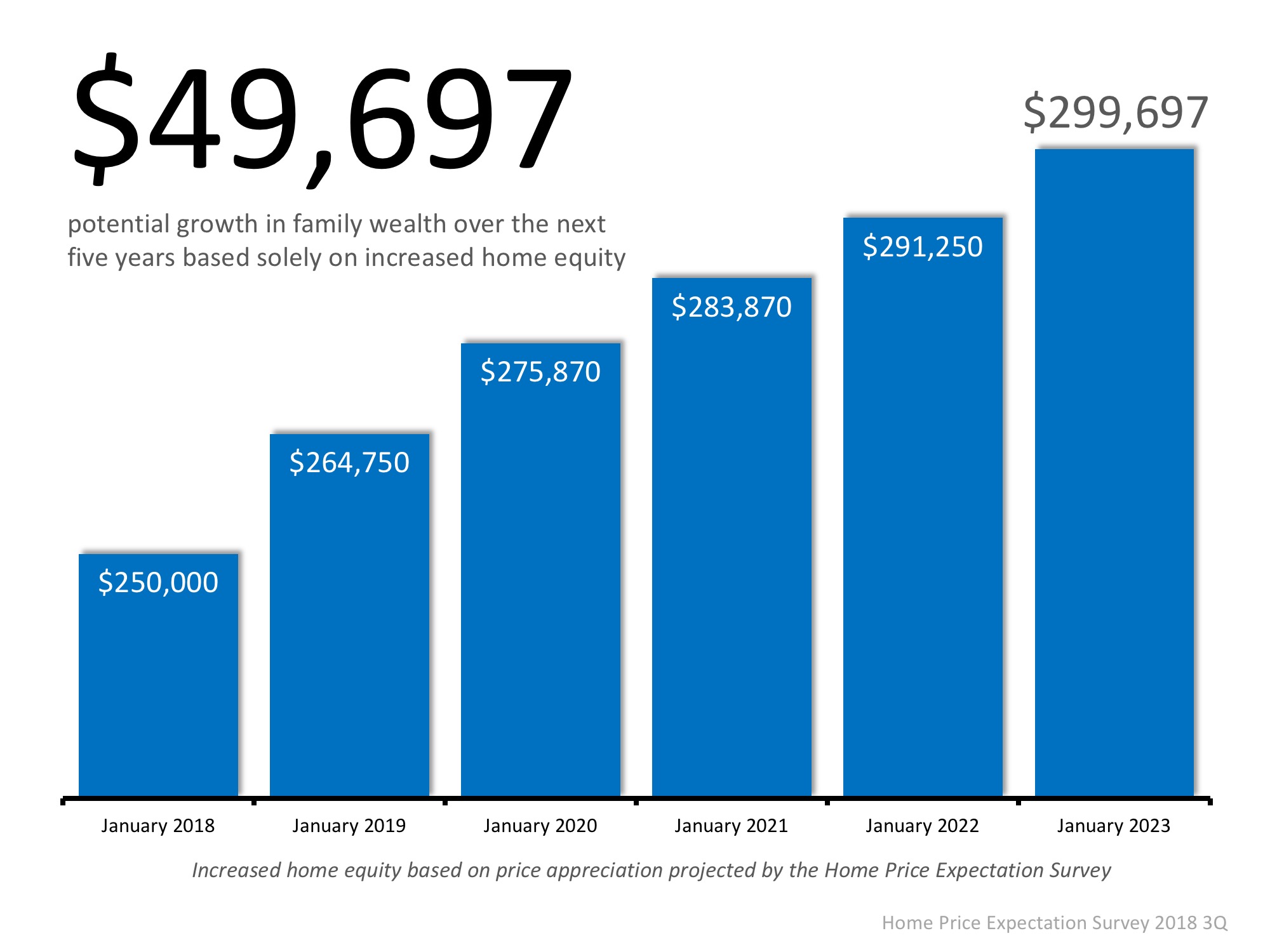
Based on results of the most recent Home Price Expectation Survey, a homeowner who purchased a $250,000 home in January would gain $50,000 in equity over the next five years based on home price appreciation alone (shown below).
The Cost of NOT Paying PMI | Simplifying The Market

Bottom Line

If you have questions about whether you should buy now or wait until you’ve saved a larger down payment, let’s get together to discuss our market’s conditions and help you make the best decision for you and your family.

Nationally, new home sales seems to be rising....

New Home Sales Up 12.7% From Last Year

The report also showed that builders have ramped up construction with an increase in new construction starts and completions. The summer months are often a busy time for builders as they capitalize on the warmer weather to be able to finish projects.
Below is a table showing the change in starts, completions, and sales from last August.
New Home Sales Up 12.7% From Last Year | Simplifying The Market
Other notable news from the report is that the percentage of new construction sales in the $200-$299k range has continued to break away from the $300-$399k range.
This shows that builders are starting to build lower-priced homes that will help alleviate some of the inventory challenges in the starter and trade-up home categories. The chart below shows the full breakdown.
New Home Sales Up 12.7% From Last Year | Simplifying The Market

What does this mean for buyers and sellers?

If you are thinking of buying or selling in today’s market, you no doubt have heard that there is a shortage of existing homes for sale which has been driving home prices up across the country. The additional new construction coming to the market could help alleviate this shortage, but we are still not back up to pre-crisis levels.

Tuesday, October 9, 2018

Home prices are still rising, but at a bit slower rate than they have been....

What’s Going On With Home Prices?

CoreLogic’s Chief Economist Frank Nothaft gave some insight into this change,
“The rise in mortgage rates this summer to their highest level in seven years has made it more difficult for potential buyers to afford a home. The slackening in demand is reflected in the slowing of national appreciation, as illustrated in the CoreLogic Home Price Index.  
National appreciation in August was the slowest in nearly two years, and we expect appreciation to slow further in the coming year.”
One of the major factors that has driven prices to accelerate at a pace of between 6-7% over the past two years was the lack of inventory available for sale in many areas of the country. This made houses a prized commodity which forced many buyers into bidding wars and drove prices even higher.
According to the National Association of Realtors’ (NAR) latest Existing Home Sales Report, we are starting to see more inventory come to market over the last few months. This, paired with patient buyers who are willing to wait to find the right homes, is creating a natural environment for price growth to slow.
Historically, prices appreciated at a rate of 3.7% (from 1987-1999). CoreLogic predicts that prices will continue to rise over the next year at a rate of 4.7%.

Bottom Line

As the housing market moves closer to a ‘normal market’ with more inventory for buyers to choose from, home prices will start to appreciate at a more ‘normal’ level, and that’s ok! If you are curious about home prices in your area, let’s get together to chat about what’s going on!

Despite mortgage rates rising, we're still near historic lows, it it time to take advantage of that and make a move?


Mortgage Interest Rates are Still Going Up… Should You Wait to Buy?


In addition to the predictions from the four major reporting agencies mentioned above, the Federal Open Market Committee recently voted “unanimously to approve a 1/4 percentage point increase in the primary credit rate to 2.75 percent.” Historically, an increase in the primary credit rate has translated to an overall jump in mortgage interest rates as well.
This has caused some purchasers to lament the fact that they may no longer be able to get a rate below 4%. However, we must realize that current rates are still at historic lows.
Here is a chart showing the average mortgage interest rate over the last several decades:
Mortgage Interest Rates are Still Going Up… Should You Wait to Buy? |Simplifying The Market

Bottom Line

Though you may have missed the lowest mortgage rate ever offered, you can still get a better interest rate than your older brother or sister did ten years ago, a lower rate than your parents did twenty years ago, and a better rate than your grandparents did forty years ago.

www.propertybysteve.com

Monday, October 8, 2018

Home prices and supply and demand, here's some thouights....


How Does the Supply of Homes for Sale Impact Buyer Demand?

Their latest edition sheds some light on the relationship between seller traffic (supply) and buyer traffic (demand).

Buyer Demand

The map below was created after asking the question: “How would you rate buyer traffic in your area?”
How Does the Supply of Homes for Sale Impact Buyer Demand? | Simplifying The Market
The darker the blue, the stronger the demand for homes is in that area. The survey showed that in 38 out of 50 states buyer demand was slightly lower than this time last year but remains strong. Only six states had a ‘stable’ demand level.

Seller Supply 

The index also asked: “How would you rate seller traffic in your area?”
As you can see from the map below, 23 states reported ‘weak’ seller traffic, 22 states and Washington D.C. reported ‘stable’ seller traffic, and 5 states reported ‘strong’ seller traffic. This means there are far fewer homes on the market than what is needed to satisfy the buyers who are out looking for homes.
How Does the Supply of Homes for Sale Impact Buyer Demand? | Simplifying The Market

Bottom Line

Looking at the maps above, it is not hard to see why prices are appreciating in many areas of the country. Until the supply of homes for sale starts to meet buyer demand, prices will continue to increase. If you are debating listing your home for sale, let’s get together so I can help you capitalize on the demand in the market now!

Perhaps we should be keeping an eye on interest rates and real estate inventory....

2 Factors to Watch in Today’s Real Estate Market Whether Buying or Selling

Interest Rates

Mortgage interest rates have been on the rise and are now over three-quarters of a percentage point higher than they were at the beginning of the year. According to Freddie Mac’s latest Primary Mortgage Market Survey, rates climbed to 4.72% for a 30-year fixed rate mortgage last week.
The interest rate you secure when buying a home not only greatly impacts your monthly housing costs, but also impacts your purchasing power.
Purchasing power, simply put, is the amount of home you can afford to buy for the budget you have available to spend. As rates increase, the price of the house you can afford to buy will decrease if you plan to stay within a certain monthly housing budget.
The chart below shows the impact that rising interest rates would have if you planned to purchase a $400,000 home while keeping your principal and interest payments between $2,020-$2,050 a month.
2 Factors to Watch in Today’s Real Estate Market Whether Buying or Selling | Simplifying The Market
With each quarter of a percent increase in interest rate, the value of the home you can afford decreases by 2.5% (in this example, $10,000). Experts predict that mortgage rates will be over 5% by this time next year.

Inventory

A ‘normal’ real estate market requires there to be a 6-month supply of homes for sale in order for prices to increase only with inflation. According to the National Association of Realtors (NAR), listing inventory is currently at a 4.3-month supply (still well below the 6-months needed), which has put upward pressure on home prices. Home prices have increased year-over-year for the last 78 straight months.
The inventory of homes for sale in the real estate market had been on a steady decline and experienced year-over-year drops for 36 straight months (from July 2015 to May 2018), but we are starting to see a shift in inventory over the last three months.
The chart below shows the change in housing supply over the last 12 months compared to the previous 12 months. As you can see, in June, July, and August, inventory levels have started to increase as compared to the same time last year.
2 Factors to Watch in Today’s Real Estate Market Whether Buying or Selling | Simplifying The Market
This is a trend to watch as we move further into the fall and winter months. If we continue to see an increase in homes for sale, we could start moving further away from a seller’s market and closer to a normal market.

Bottom Line

If you are planning to enter the housing market, either as a buyer or a seller, let’s get together to discuss the changes in mortgage interest rates and inventory and what they could mean for you.

Are we shifting from a seller's market to a buyer's market? Here's some thoughts....

Are We About to Enter a Buyers’ Market?

The market has definitely softened. However, according to two chief economists in the industry, we are a long way from a market that totally favors the purchaser:

Dr. Svenja Gudell, Zillow Chief Economist:

“These seller challenges don’t indicate we’re suddenly in a buyers’ market – we don’t expect market conditions to shift decidedly in favor of buyers until 2020 or later. But buyers certainly are starting to balk at the rapid rise in prices and home values are starting to grow at a less frenetic pace.”

Danielle Hale, Chief Economist of realtor.com:

“The signs are pointing to a market that’s shifting toward buyers. But, in most places, we’re still a long way from a full reversal.”
In addition, Pulsenomics Inc. recently surveyed over one hundred economists, real estate experts, and investment & market strategists and asked this question:
“When do you expect U.S. housing market conditions to shift decidedly in favor of homebuyers?”
Only 5% said the market has already shifted. Here are the rest of the survey results:
Are We About to Enter a Buyers’ Market? | Simplifying The Market

Bottom Line

The market is beginning to normalize but that doesn’t mean we will quickly shift to a market favoring the buyer. We believe Ivy Zelman, author of the well-respected ‘Z’ Report, best explained the current confusion:
“With the rate of home price appreciation starting to decelerate alongside the uptick in inventory…we expect significant debate about whether this is a bullish or bearish sign.
In our view, the short-term narrative will probably be confusing, but more sustainable growth and affordability will likely be the end result.”

Search current real estate listings in Corvallis, Albany, Salem and Philomath Oregon here. 

We had a fantastic sunrise in the Corvallis area a few days back....

Photo courtesy of my friend Roger, who texted it to me that morning.

Some reasons to own your own home...

The True Cost of NOT Owning Your Home

Realtor.com reported that:
“Buying remains the more attractive option in the long term – that remains the American dream, and it’s true in many markets where renting has become really the shortsighted option…as people get more savings in their pockets, buying becomes the better option.”

What proof exists that owning is financially better than renting?

1. In a previous blog, we highlighted the top 5 financial benefits of homeownership:
  • Homeownership is a form of forced savings.
  • Homeownership provides tax savings.
  • Homeownership allows you to lock in your monthly housing cost.
  • Buying a home is cheaper than renting.
  • No other investment lets you live inside of it.
2. Studies have shown that a homeowner’s net worth is 44x greater than that of a renter.
3. Less than a month ago, we explained that a family that purchased an average-priced home at the beginning of 2018 could build more than $49,000 in family wealth over the next five years.
4. Some argue that renting eliminates the cost of taxes and home repairs, but every potential renter must realize that all the expenses the landlord incurs are already baked into the rent payment – along with a profit margin!

Bottom Line

Owning your home has many social and financial benefits that cannot be achieved by renting.

Friday, October 5, 2018

Should I rent or buy a home? Food for thought....

Buying a Home is Cheaper than Renting in 38 States! [INFOGRAPHIC]

Some Highlights:

  • According to a study by GOBankingRates, it is cheaper to buy a home than rent in 38 states across the country.
  • In six states the difference between buying & renting would account for less than a $50 monthly difference, leaving the choice up to the individual family.
  • Nationwide, it is now 26.3% cheaper to buy.

Monday, October 1, 2018

How's the real estate market?


Is the Real Estate Market Finally Getting Back to Normal?


After the bubble burst in June 2007, values depreciated 6.1% annually until February 2012. From March 201appreciating 6.2% annually.
2 to today, the market has been recovering with values
These wild swings in values were caused by abnormal ratios between the available supply of inventory and buyer demand in the market. In a normal market, there would be a 6-month supply of housing inventory.
When the market hit its peak in 2007, homeowners and builders were trying to take advantage of a market that was fueled by an “irrational exuberance.”
Inventory levels grew to 7+ months. With that many homes available for sale, there weren’t enough buyers to satisfy the number of homeowners/builders trying to sell, so prices began to fall.
Then, foreclosures came to market. We eventually hit 11 months inventory which caused prices to crash until early 2012. By that time, inventory levels had fallen to 6.2 months and the market began its recovery.
Over the last five years, inventory levels have remained well below the 6-month supply needed for prices to continue to level off. As a result, home prices have increased over that time at percentages well above the appreciation levels seen in a more normal market. 

That was the past. What about the future?

We currently have about 4.5-months inventory. This means prices should continue to appreciate at above-normal levels which most experts believe will happen for the next year. However, two things have just occurred that are pointing to the fact that we may be returning to a more normal market.

1. Listing Supply is Increasing

Both existing and new construction inventory is on the rise. The latest Existing Home Sales Reportfrom the National Association of Realtors revealed that inventory has increased over the last two months after thirty-seven consecutive months of declining inventory. At the same time, building permits are also increasing which means more new construction is about to come to market. 

2. Buyer Demand is Softening

Ivy Zelman, who is widely respected as an industry expert, reported in her latest ‘Z’ Report:
 “While we continue to expect a resumption of growth in resale transactions on the back of easing inventory in 2019 and 2020, our real-time view into the market through our Real Estate Broker Survey does suggest that buyers have grown more discerning of late and a level of “pause” has taken hold in many large housing markets.
Indicative of this, our broker contacts rated buyer demand at 69 on a 0- 100 scale, still above average but down from 74 last year and representing the largest year-over-year decline in the two-year history of our survey.”
With supply increasing and demand waning, we may soon be back to a more normal real estate market. We will no longer be in a buyers’ market (like 2007-February 2012) or a sellers’ market (like March 2012- Today).
Prices won’t appreciate at the levels we’ve seen recently, nor will they depreciate. It will be a balanced market where prices remain steady, where buyers will be better able to afford a home, and where sellers will more easily be able to move-up or move-down to a home that better suits their current lifestyles.

Bottom Line

Returning to a normal market is a good thing. However, after the zaniness of the last eleven years, it might feel strange. If you are going 85 miles per hour on a road with a 60 MPH speed limit and you see a police car ahead, you’re going to slow down quickly. But, after going 85 MPH, 60 MPH will feel like you’re crawling. It is the normal speed limit, yet, it will feel strange.
That’s what is about to happen in real estate. The housing market is not falling apart. We are just returning to a more normal market which, in the long run, will be much healthier for you whether you are a buyer or a seller.